

 [email protected] Request a Quote
  Call Us +86-371-66859535

Electrolytic Gold Refining: From Crude Gold to 99.99% Purity
Electrolytic gold refining is the most reliable way to turn impure gold into ultra-high-purity metal for bullion and high-tech applications.
Step 1: Making the Anodes
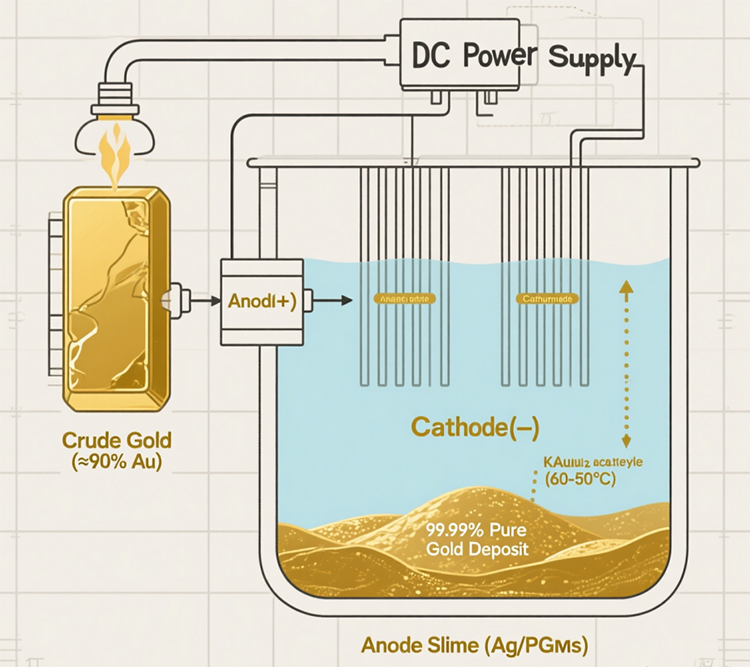
We start with our crude feed – call it 90% gold, give or take. In electrolytic gold refining, this material is first melted down and cast into thick, flat slabs. These will be our sacrificial anodes.
Before they go in the tank, each one gets a sock – a polypropylene anode bag. This bag is crucial. It lets the gold ions pass through into the solution but catches all the solid gunk that falls off, the “anode slime.” That slime is where the silver and other precious metals hang out, and we’ll recover them later.
Step 2: Hooking It All Up
The anodes in their bags, and shiny blank starter sheets (titanium, usually) that will become our cathodes, get hung on busbars in the electrolytic gold refining cell.
The cell is full of a hot (around 65 °C) solution of potassium gold cyanide – that’s our electrolyte, the highway for the gold. The anodes are connected to the positive output and the cathodes to the negative output of the DC rectifier. Once power is supplied, the electrolytic gold refining cycle starts.
Step 3: The Electrochemical Stage
Once the current is on, a controlled dance begins – the heart of electrolytic gold refining:
At the Anode (POSITIVE):
The impure gold slowly dissolves. The gold atoms give up electrons and become positively charged ions in the solution. Most base metals dissolve too, but the real precious stuff like silver and the PGMs drop off as a sludge, right into those anode bags.
In the Solution: Those gold ions, now in a stable complex, are pulled through the electrolyte towards the negative cathode.
At the Cathode (NEGATIVE): Here, the gold ions get their electrons back. They plate out, atom by atom, onto the starter sheet. Under the right voltage and chemistry, electrolytic gold refining is highly selective. The impurities mostly stay in solution. What builds up is a layer of extremely pure gold – typically 99.99% purity or better.
Step 4: Pulling Product & Closing the Loop
After a run (which can take a couple of days), we power down.
Harvesting Gold:
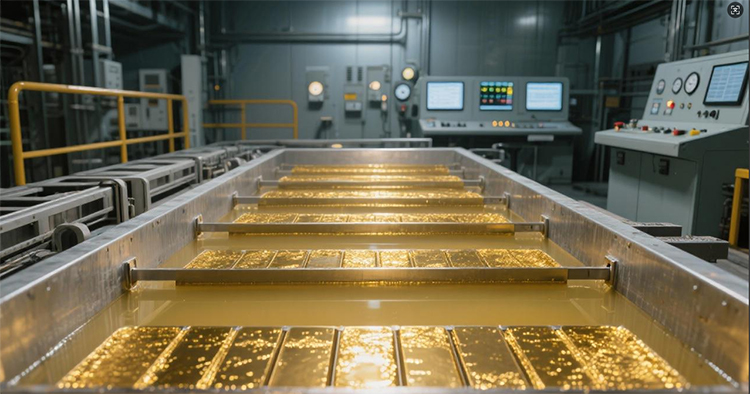
We pull the cathodes. The gold deposit – now a thick, matte coating – is peeled or scraped off. We melt that sponge gold down with a bit of borax (to clean it up) and cast a beautiful, shiny bar.
Dealing with the Sludge:
Those anode bags are emptied. The black “slime” inside is processed separately to recover the silver, platinum, and palladium – an important secondary value stream in electrolytic gold refining.
Minding the Bath:
The electrolyte is not thrown out. It is continuously monitored, filtered, and tested for gold content and free cyanide strength. Adjustments are made to keep the bath stable, ensuring consistent results run after run.
Step 5: What Comes Out the Door
In the end, electrolytic gold refining produces three output streams:
The primary output is a fine gold bar, typically 1 kilogram or more, suitable for commercial and industrial use.
The Bonus Round: Concentrated sludges of silver and PGMs, sent to their own refining circuits.
The Waste (Minimized and Treated): Any bleed stream from the electrolyte is detoxified through a cyanide destruction system, so only treated water is discharged.